NTDLL unhooking rants
NTDLL Unhooking rants
Disclaimer: This blog is NOT a tutorial about unhooking NTDLL - it’s more of a rant about the different things I have encountered while unhooking NTDLL - memory permissions, VADs, mapping stuff, which I think other people might find interesting.
So a while back, I was writing a little payload which was unhooking NTDLL from a process by mapping it from KnownDlls. Pretty simple, right? Here is a pseudo-snippet of the code which was responsible for mapping ntdll from KnownDlls into memory:
1 | |
Now, since we are mapping things to memory, we should have two copies of NTDLL in the current process memory:

The first question on my dumb mind is “Why is this mapped as a module?”. First things first, we inspect the \KnownDlls\ntdll.dll object.
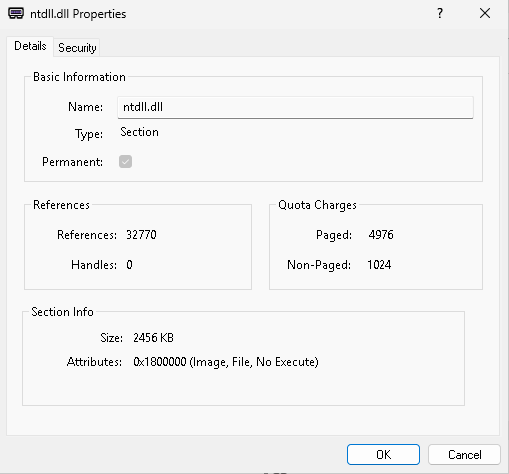
So it’s a SEC_IMAGE object. I am assuming smss.exe is the one responsible for creating it at boot time, but just to be sure, set Procmon to log boot time events and with some filtering, we get the following:
| Process Name | PID | Operation | Path | Result | Detail |
|---|---|---|---|---|---|
| smss.exe | 512 | Load Image | C:\Windows\System32\ntdll.dll | SUCCESS | Image Base: 0x7ff901ea0000, Image Size: 0x266000 |
| smss.exe | 512 | CreateFile | C:\Windows\System32\ntdll.dll | SUCCESS | Desired Access: Execute/Traverse, Read Control, Synchronize, Disposition: Open, Options: Synchronous IO Non-Alert, Non-Directory File, Attributes: n/a, ShareMode: Read, Delete, AllocationSize: n/a, OpenResult: Opened |
| smss.exe | 512 | CreateFileMapping | C:\Windows\System32\ntdll.dll | FILE LOCKED WITH ONLY READERS | SyncType: SyncTypeCreateSection, PageProtection: PAGE_EXECUTE |
| smss.exe | 512 | CreateFileMapping | C:\Windows\System32\ntdll.dll | SUCCESS | SyncType: SyncTypeOther |
| smss.exe | 512 | Load Image | C:\Windows\System32\ntdll.dll | SUCCESS | Image Base: 0x1fd86800000, Image Size: 0x266000 |
| smss.exe | 512 | CloseFile | C:\Windows\System32\ntdll.dll | SUCCESS |
The key eveny here is the CreateFileMapping opetation with SyncType: SyncTypeCreateSection and PageProtection: PAGE_EXECUTE. This is Process Monitor’s representation of NtCreateSection being called with SEC_IMAGE semantics.
Here is how the flow happens: smss.exe reads C:\Windows\System32\ntdll.dll from disk, Creates a section object (the FILE LOCKED WITH ONLY READERS result is normal; it means the file system acquired a shared lock for the section creation), verifies the image (LoadImage) and then closes the handle to file on disk. Cool, now we can go back to answering our question - “Why does this show up as a mapped module?”
For this we need to first ask: “Hey how does System Informer know which modules are loaded into a process?”
So System Informer does not just walk the PEB/LDR (which I initially thought), it also uses Virtual Address Descriptors. From Windows Internals Part 1:
When a process reserves address space or maps a view of a section, the memory manager creates a VAD to store any information supplied by the allocation request, such as the range of addresses being reserved, whether the range will be shared or private, whether a child process can inherit the contents of the range, and the page protection applied to pages in the range.
When know smss.exe creates the section object with SEC_IMAGE, which tells the kernel memory manager: “this section backs a PE image”(See the documentation for CreateFileMappingW). When we map it using MapViewOfFile(), the kernel DOES NOT perform a flat byte-for-byte file mapping. It then proceeds to map each PE section at its virtual address offset (not raw file offset) - .text at one RVA, .data at another, etc. Again from Windows Internals:
The section object pointers structure points to one or two control areas. One control area is used to map the file when it is accessed as a data file and the other is used to map the file when it is run as an executable image. A control area in turn points to subsection structures that describe the mapping information for each section of the file (read-only, read/write, copy-on write, and so on). The control area also points to a segment structure allocated in paged pool, which in turn points to the prototype PTEs used to map to the actual pages mapped by the section object.
This tells us:
- Image files get a distinct image control area (separate from the data control area)
- The control area points to subsection structures, one per PE section: each describing a different range of the file with its own protection attributes
- The segment’s prototype PTEs are what ultimately map virtual addresses to physical page
The memory manager tags every page in the resulting region with memory type MEM_IMAGE (0x1000000) - so ideally, we should be able to use NtQueryVirtualMemory() with MemoryMappedFilenameInformation to get some of this information:
1 | |
Calling this function before and after mapping ntdll verifies our claim:
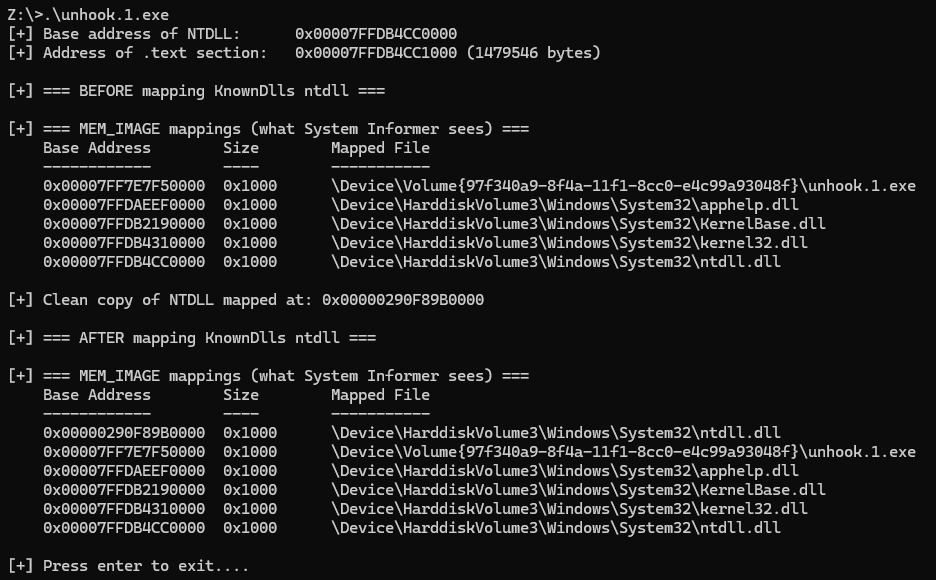
So, we know now how System Informer gets its information. Cool. Time to move on (we still have opsec considerations but we would ignore that for now).
Time to copy the clean .text section. For testing, we would be using Frida to hook NtAllocateVirtualMemory()1
1 | |
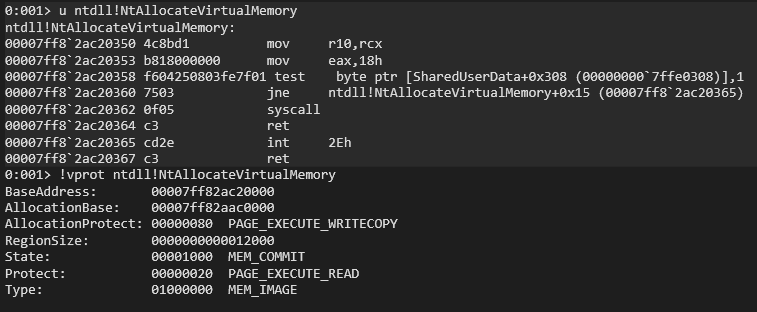
Pre-hooking the address looks like this:
After-hooking the address looks like:
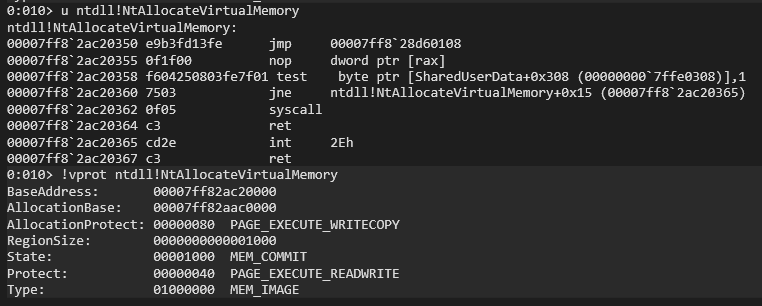
The biggest change we see is that the memory protection for the changes from PAGE_EXECUTE_READ to PAGE_EXECUTE_READWRITE. So this gives me the idea: Instead of mapping the entirity of .text section, how about we just map the pages with RWX permissions? Time to write some code!
Here is the function we write:
1 | |
Pretty simple stuff (not the best code - but we make do). Now let’s do the Frida hooking again:
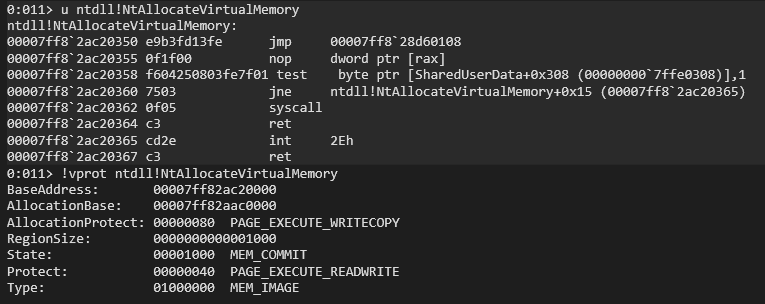
Now, hitting Enter should overwrite this hook:
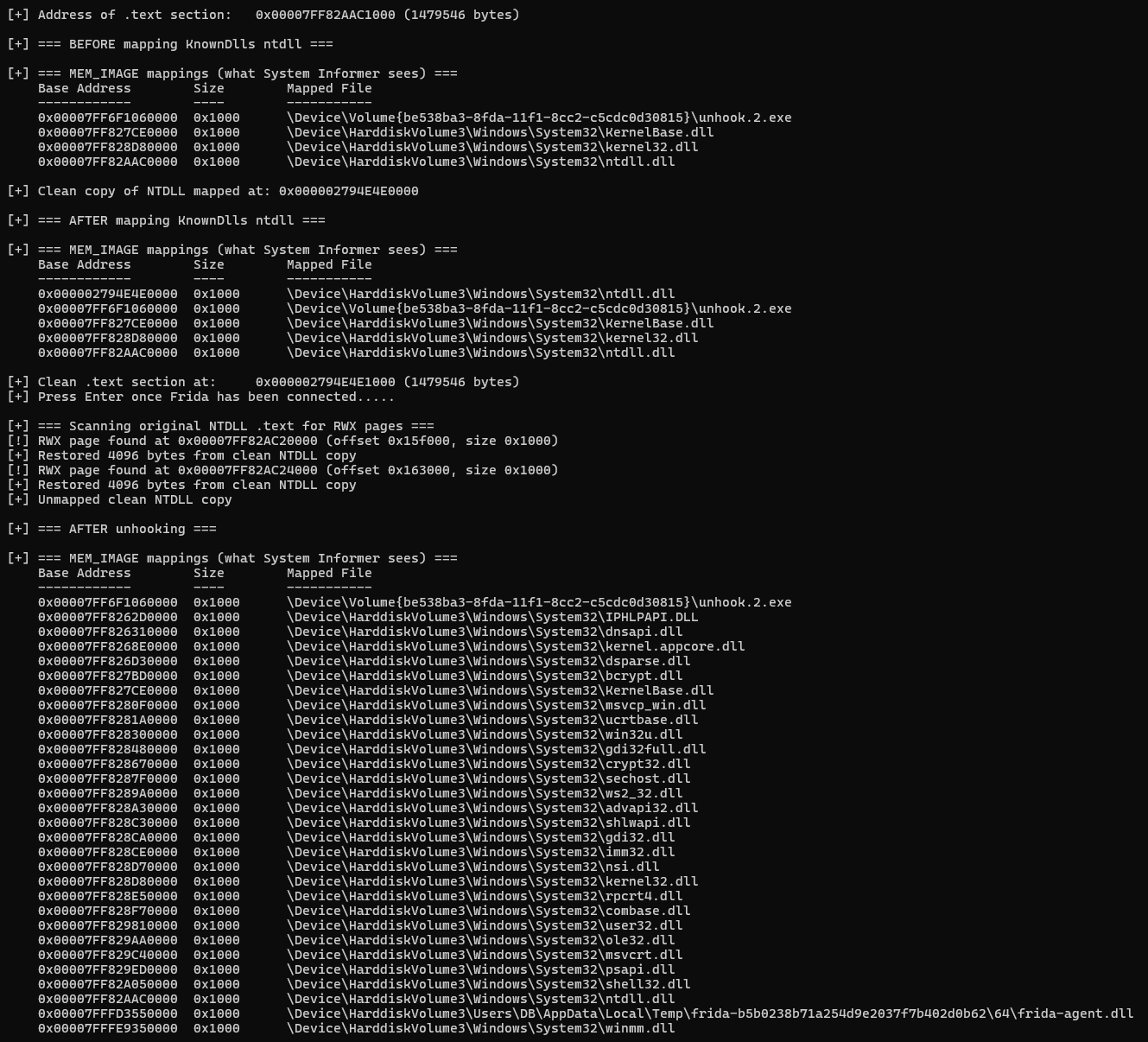
And on windbg side of things:
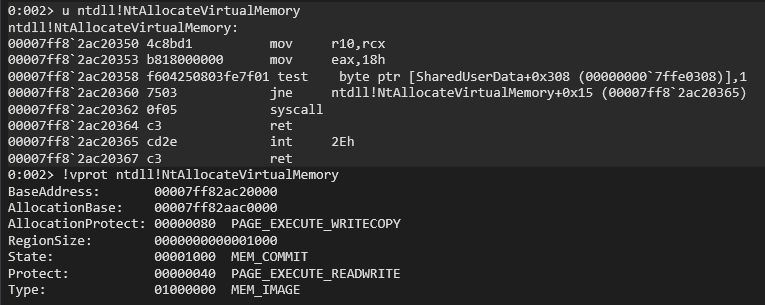
So, we are able to overwrite the hook. Unmapping the section also removes it from the list of loaded modules. Now while I do want to say that this RWX memory region can be an indicator of an EDR hook but from testing, it turns out that they usually revert back to RX permissions. I guess we can use NtQueryVirtualMemory(MemoryWorkingSetExInformation) to find private pages but that is left as an exercise to the reader ;)
Another good exercise for the reader would be to get rid of the Second NTDLL loaded IoC (even I am experimenting with some stuff - will publish some stuff when I am a bit more confident). Till next time - Ciao.